

New format to decide Asia’s Women’s Olympic qualifiers

The battle for the final two spots to join hosts and reigning Asian champions Japan, at the Women’s Football Tournament at the Tokyo Olympics 2020 will be decided in a new and innovative qualifying tournament.

The Continent’s remaining women’s sides will learn their fate in the Asian Qualifiers Final Round Draw at the AFC House in Kuala Lumpur, Malaysia.

The revamped qualifying format for the 2020 edition will see the eight remaining teams divided into two groups, with the top two sides advancing to the two-legged play-offs to decide the final two Asian qualifiers.

This will give the Continent’s elite teams the opportunity to play their most significant matches in front of their home fans.

After two qualifying rounds of captivating action, the initial cast of 18 was whittled down to three with Myanmar, Vietnam and Chinese Taipei joining Australia, China PR, DPR Korea, Korea Republic and Thailand who reached the final round automatically as the highest ranked teams during the first round of qualifiers.

Following the outcome of the latest FIFA Ranking released on September 27, 2019, the Continent’s top-ranked sides Australia and DPR Korea will be placed in Pot 1, joint hosts for the final round, China PR and Korea Republic are in Pot 2, followed by Vietnam and Thailand in Pot 3 and Chinese Taipei and Myanmar confirming their places in the final pot.

The Asian Qualifiers Final Round will take place from February 3 to 9, 2020 with the two-legged play-off scheduled to take place on March 6 and 11, 2020.

Football at the Tokyo 2020 Olympics will commence with the women’s matches on July 22 – two days before the Games’ official opening ceremony – with the men’s competition to begin on July 23. The 12-team women’s tournament will conclude on August 7, with the men’s tournament to conclude the following day.

Asian teams have established a long and proud tradition at the Olympic Games, with China PR (1996) and Japan (2012) winning silver in the women’s tournament, while Japan (1968) and Korea Republic (2012) clinched the bronze medals in the men’s competition.


Previous ArticleNext Article

GIS Masterclass: Fan Engagement and Marketing with Terry Lynam and Karen Grega

The Global Institute of Sport recently hosted a masterclass on Fan Engagement and Marketing, bringing together two industry leaders to tackle the field’s most pressing issues.

The Global Institute of Sport (GIS), which offers a Master’s in Sports Business and Sports Analytics through the University of Newcastle, regularly holds masterclasses with industry leaders as part of its curriculum.

The latest focused on fan engagement and marketing, covering two key themes: the growing tension between live sport and online streaming, and the role of data in shaping the fan experience.

The panelists 

Terry Lynam recently concluded her role as General Manager of Fan Experience and Events at Football Australia, overseeing the AFC Women’s Asian Cup on home soil.

Karen Grega is an experienced sports management consultant with a multi-code background. She currently represents Football Coaches Australia (FCA) and Heartbeat of Football, and has previously worked with Sydney Cricket Ground, Venues NSW and Sydney FC.

Live Sport and social media.

Terry Lynam opened with a pointed statement — one she acknowledged would be controversial. She argued that the sense of community unique to live sport is being eroded by social media and ‘snippet’ consumption.

Central to her concern is how marketing teams are failing to segment their audiences, treating casual online viewers the same as matchday fans.

“If they aren’t spending money on the sport we shouldn’t count them as spectators to the same level as match going fans.”

“What we want to consider as marketeers is how much we want to give away and how much we want our live sport element to remain,” Lynam said.

Grega echoed the sentiment, arguing fan engagement ultimately comes down to human connection. “It’s not rocket science.”

She suggested the industry revisit the concept of sport as a family outing to recapture that communal experience.

Data Driving Decisions

Both panelists highlighted data and analytics as central to modern fan engagement.

Grega recalled the introduction of computerised turnstiles as a turning point, enabling teams to track crowd movements and optimise staffing and entry times.

She also noted the continued value of fan surveys in informing marketing decisions.

Lynam pointed to ticketing technology as a significant data frontier.

Modern platforms like Ticketmaster’s ticket-transfer system now provide detailed customer insights.

“It allows us to have a better understanding of who’s getting the ticket and how they transport themselves there or when they arrive,”

“We can personalise their journey and sell content to them,” Lynam commented. 

The discussion also touched on data sourced from social media and on-field player tracking, as well as interactive stadium technology gaining traction in the US.

This included holographic assistants and player headset interactions that bring a broadcast-style experience to live events.

Activations That Educate

Activations rounded out the masterclass, with Lynam detailing how she created a fan zone on a modest budget for the Women’s Asian Cup.

The activation featured charitable partnerships focused on women’s health, including Heartbeat of Football, Endometriosis Australia and Share the Dignity.

“I’m very hopeful that that type of idea gets pushed through on other sporting events,” Lynam said.

Grega elaborated on the Heartbeat of Football activation, highlighting how a competitive element built around CPR and heart health kept fans engaged while also educating them.

“The whole health hub ticked all the boxes — it was immersive, it was interactive, it was there for all ages, both sexes.”

“That sort of blueprint is one that should be replicated as much as possible,” Explained Karen Grega

The masterclass offered students and industry professionals a valuable window into contemporary sports marketing.

As the competition for fan attention intensifies, the blend of live experience, smart data use, and purposeful activations can help define the next chapters of fan engagement.

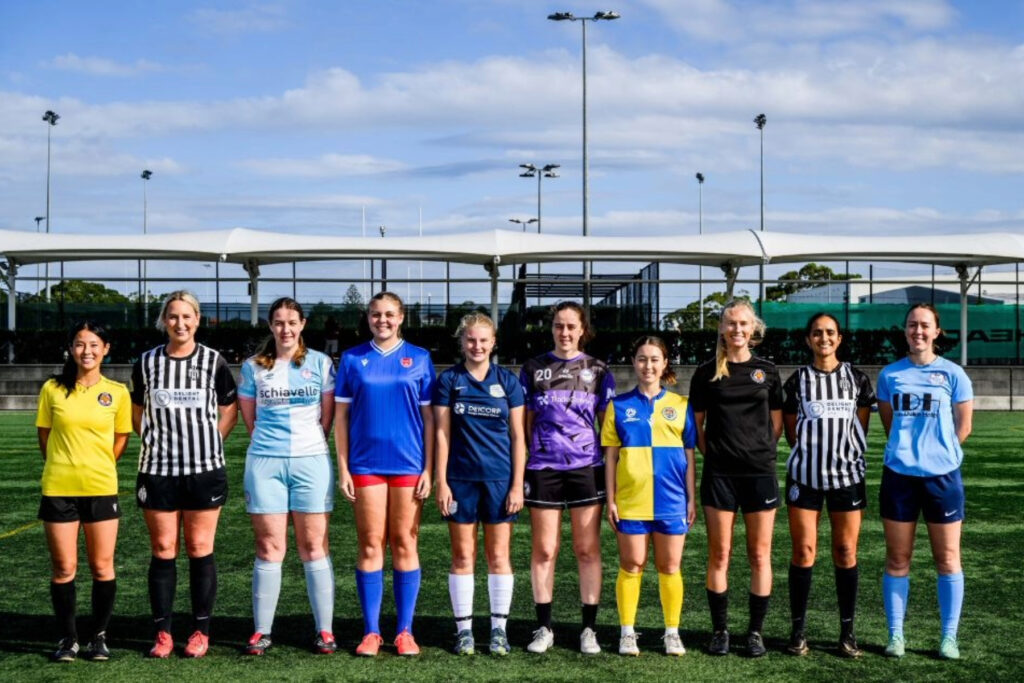
Eastern Suburbs Football Association Announces First All-Female Referee Course and Expanded Women’s Competition

The Eastern Suburbs Football Association has opened its 2026 season with three structural investments that reflect the growing ambition of community football associations to address participation, representation and development gaps simultaneously, beginning with the delivery of its first all-female Football Match Official Course.

The course, held at Matraville Sports High School and led by female liaison committee member Michelle Hilton and 2025 Referee of the Year Ariella Richards, brought 25 new female referees into the association ahead of Round 1. The initiative targets one of the most persistent imbalances in community sport, with women remaining significantly underrepresented in officiating roles at every level of the game, by creating a dedicated entry point separate from the mixed course environment that many women find unwelcoming.

The Women’s Premier League has also expanded, now featuring eleven teams and introducing a WPL1 and WPL2 structure following the first ten rounds of the season. The tiered format creates more competition opportunities for clubs across the region while providing a clearer development pathway for teams at different stages of growth. Returning clubs Randwick City, Glebe Wanderers, Easts FC and Sydney University join established sides in what the association describes as one of its most competitive women’s seasons. ESFA clubs have continued to perform strongly in state-wide competitions including the Football NSW Sapphire Cup, State Cup and Champion of Champions.

Building the next generation

The season opened with an inaugural Development League Gala Day for Under-9 to Under-12 boys and girls, bringing eight clubs together in a structured development environment ahead of Round 1. Sydney FC A-League Women’s players attended the event and engaged directly with young participants, a deliberate effort to connect grassroots players with visible examples of where the pathway leads.

“We are committed to creating more opportunities for clubs, players, coaches and referees to thrive, with a strong focus on participation opportunities to suit participants of all abilities and aspirations,” said ESFA CEO John Boulous.

The three initiatives, a new referee entry point for women, an expanded women’s competition structure, and a development-focused junior gala day with elite role models present, together reflect an association responding to the participation pressures the AFC Women’s Asian Cup has brought into sharp relief across Australian football.

Most Popular Topics

Editor Picks

Send this to a friend